Most homes across Wesley Chapel sit on a concrete slab, with water lines running underneath or through it. When one of those lines fails, the water has nowhere to go but into the soil under your foundation — and it will keep going for weeks or months before most homeowners notice.
A common assumption in newer communities is that a slab leak is an old-house problem. It is far less common in PEX construction than it was in the copper-and-polybutylene era, but "less common" is not "impossible," and a house well under fifteen years old can still develop one. Here is what to watch for.
1. A Warm Spot on the Floor
This is the classic one and it is worth taking seriously. If a hot water line under the slab develops a leak, the heat radiates up through the concrete and the tile above it. Walk your floors barefoot in the morning before the sun has hit them. A patch that is noticeably warmer than the rest of the room, in a spot with no obvious reason to be warm, is a hot-side slab leak until proven otherwise.
2. A Water Bill That Jumped for No Reason
A pinhole leak under a slab can push through 5,000 to 10,000 gallons a month. If your bill climbed and your habits did not change — no new irrigation schedule, no houseguests, no filled pool — water is escaping somewhere.
There is a free five-minute test for this. Turn off every fixture and appliance that uses water, including irrigation and pool auto-fill. Go to your meter and look at the low-flow indicator, the small triangle or dial that spins on tiny flows. If it is still moving with everything off, you have an active leak on your side of the meter.
3. The Sound of Running Water With Everything Off
Stand in a quiet house late at night and listen. Pressurized water escaping a pipe makes a faint continuous hiss or rush that carries surprisingly well through concrete. People often describe it as a shower running in another room. If you hear it and nothing is on, that sound has a source.
4. Damp Carpet, Baseboards or a Musty Smell
Water under a slab does not stay under it. It wicks up through the concrete and into whatever is on top — carpet padding, baseboards, the bottom plate of a wall. A single persistently damp area, or a musty odor concentrated in one room, points to moisture coming from below rather than from a roof or window.
5. Cracking Tile or a Floor That Feels Uneven
Sustained moisture washes fine material out from under a slab and softens the soil beneath. As support shifts, the concrete moves slightly — enough to crack grout lines, lift tile at the edges, or make a floor feel subtly wrong underfoot.
6. Low Water Pressure That Appeared Out of Nowhere
Pressure that drops gradually over years is usually scale narrowing your fixture supply lines. Pressure that drops noticeably over a few weeks is different — it can mean a meaningful volume of water is leaving the system before it reaches your fixtures. If the drop is on the hot side only, that narrows it to the hot supply line under the slab.
7. Mold or Mildew You Cannot Explain
Consistent moisture plus Florida humidity plus a dark cavity is a mold recipe. Mildew appearing along the bottom of a wall, inside a closet on an exterior wall, or under cabinets on a slab floor deserves investigation. The visible mold is the symptom; the moisture source is the problem.
Why It Still Happens in Newer PEX Homes
PEX is a genuinely good, leak-resistant material, and it is a big part of why slab leaks are less common in Wesley Chapel's newer communities like Epperson and Watergrass than they were in older copper-and-polybutylene neighborhoods. But a fitting can fail, a crimp connection can loosen over years of pressure cycling, or a line resting against rebar or aggregate can wear through under constant water hammer. None of that requires the house to be old — it requires years of normal operating stress, which any home eventually accumulates.
What Happens Next
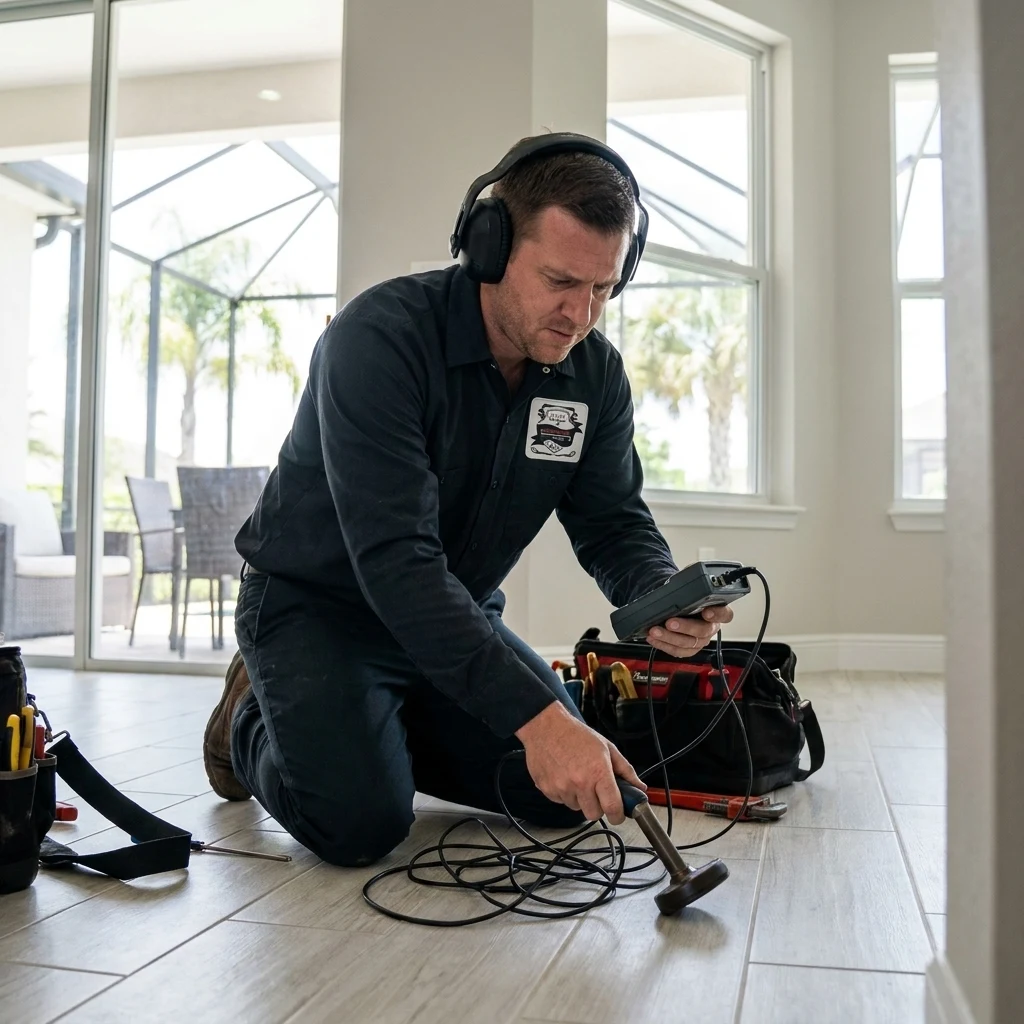
The single most important part of slab leak work is locating, not repairing. Anyone can break concrete. We use acoustic listening equipment, thermal imaging and line tracing to pinpoint the leak within a few inches so the opening is the size of a dinner plate rather than a doorway. See our leak detection page for how the equipment works.
From there you have three paths. A spot repair opens the slab and replaces the failed section — cheapest, and right when the rest of the pipe is sound. A reroute abandons the underslab line and runs new pipe through the attic and down the walls, avoiding concrete work entirely. A full repipe, detailed on our installation page, replaces everything and is the correct answer only when the pipe material itself is compromised throughout.
What the Repair Costs
Leak detection itself runs $200 to $450 in Wesley Chapel and is usually credited toward the repair if the same company does the work. A spot repair through the slab typically lands between $900 and $2,200 including breaking and patching the concrete. A reroute runs $1,200 to $2,800 per line.
Document everything before you clean up or repair. Many policies cover the resulting water damage and the cost of accessing the pipe even when they exclude the pipe repair itself, and photos taken before the work are worth far more than a description afterward.
If you have two or more of the seven signs above, do the meter test today. It costs nothing and it will tell you whether you are dealing with a real leak or a coincidence.
Need this handled instead of researched?
Licensed, insured, same-day service across Wesley Chapel. Free written estimate, honored 30 days, and we beat any written quote from a licensed competitor.
CALL 813-733-7188Slab Leak FAQs in Wesley Chapel, FL
Months, routinely. Under a slab there is nothing visible to see and nothing dripping into a pan. Most of the slab leaks we find in Wesley Chapel had been running for six weeks or more, which is why the water bill and the meter test matter so much as early warnings.
It can. Continuous water washes fine material out from under the concrete and softens the soil supporting it. Cracking tile and uneven floors are the slab telling you support has shifted.
Detection runs $200 to $450 and we credit it toward the repair if we do the work. That buys acoustic listening, thermal imaging and line tracing so the concrete opening is the size of a dinner plate instead of a doorway.
Almost always, though a small pinhole may only add ten or twenty dollars at first. The more reliable test is the meter: shut every fixture and irrigation zone off and watch the low-flow indicator. If it still turns, water is leaving the system somewhere.
Policies commonly cover the resulting water damage and the cost of accessing the pipe while excluding the pipe repair itself. It varies by carrier. Photograph everything before any work starts and call your agent early — we can provide a written report of what we located and how.