Wesley Chapel Leak Detection and Slab Leaks
Hidden leaks are expensive twice: once on the water bill and again on the flooring and drywall they quietly destroy. The average slab leak in a Wesley Chapel home runs for weeks before anyone notices, and homeowners are often surprised that a house built in the last fifteen years can have one at all.
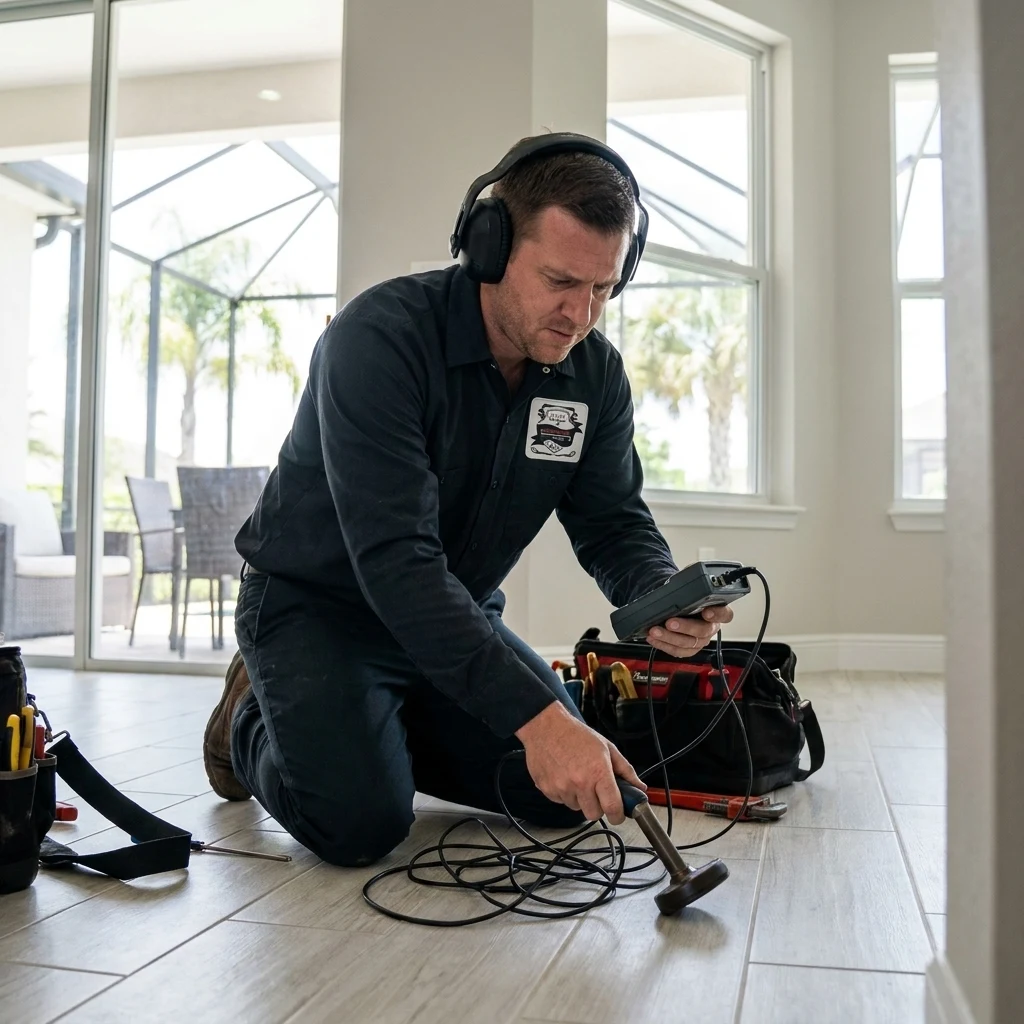
The most important part of this job is not the repair — it is the locating. Anybody can break concrete. We use acoustic listening equipment, thermal imaging and line tracing to pinpoint the leak within inches so the opening is the size of a dinner plate instead of a doorway.
Signs You Have a Hidden Leak
Call us if you notice any of these, especially more than one at a time:
- A water bill that jumped with no change in habits
- A warm or hot spot on a tile or concrete floor
- The sound of running water when every fixture is off
- Damp carpet, baseboards or a musty smell in one area
- Cracking or lifting tile, or a floor that suddenly feels uneven
- Mildew or discoloration on a wall or ceiling
- Water meter that keeps creeping with the main shut off at the house
- Low water pressure that appeared out of nowhere
Why New Construction Is Not Immune
Most Wesley Chapel homes sit on a concrete slab with PEX supply lines running underneath or through it, and homeowners assume newer means safer. PEX is a good material, but a leak still happens at a fitting, a crimp that was never fully seated, or a spot where the line rubs against rebar or aggregate under constant water hammer. It happens less often than it did with older copper and polybutylene, but a fifteen-year-old Wesley Chapel home having its first slab leak is not unusual.
The other source we see constantly in this market is irrigation and pool equipment plumbed close to the house — a cracked fitting on a sprinkler zone valve or a pool auto-fill line can mimic a slab leak symptom for symptom, right down to the spinning meter. Part of what we do on a service call is rule that out first, because it is a much cheaper fix than opening a floor.

How the Repair Works and What It Costs
Once located, there are three options and we will lay out all of them. Spot repair opens the slab at the leak and replaces that section — cheapest, best when the pipe is otherwise sound, typically $900–$2,200 including concrete. Reroute abandons the failed line and runs new pipe overhead through the attic and down the walls — no concrete work at all, usually $1,200–$2,800 per line. Full repipe replaces everything in PEX, $4,500–$12,000 depending on size and finish work.
Leak detection itself runs $200–$450 and is credited toward the repair if you have us do the work. You get the location and the findings either way — that information is yours.
Get a written price today
Free estimate, no obligation, honored for 30 days — and we beat any written quote from a licensed competitor in greater Wesley Chapel.
CALL 813-733-7188Serving Wesley Chapel and the Surrounding Communities
We handle leak detection and slab leaks throughout Wesley Chapel, Seven Oaks, Meadow Pointe, Union Park, Epperson, Watergrass, Chapel Pines, Bruce B. Downs, New Tampa, Tampa, Land O' Lakes, Lutz, Dade City, Zephyrhills, Lakeland, Plant City and San Antonio, FL. If you are not sure whether we reach your street, call or text — the answer is usually yes.
Leak Detection and Slab Leaks FAQs
Acoustic listening equipment picks up the sound of pressurized water escaping the pipe, thermal imaging shows the heat signature of a hot-side leak, and line tracing maps where the pipe actually runs. Together they get us to within a few inches before anything is opened.
Policies commonly cover the resulting water damage and the cost of accessing the pipe, while excluding the pipe repair itself. It varies by carrier and policy. Document everything, call your agent early, and we will provide a written report of what we found.
Yes, though it is less common than in older construction. PEX fittings, crimp connections and spots where a line contacts rebar or aggregate can all fail under years of water hammer and pressure cycling, even in a home under fifteen years old.
A pinhole leak can push through 5,000 to 10,000 gallons a month. That is a water bill several times normal, plus continuous moisture under the slab, which is how mold problems start.
Shut every fixture off and watch the meter, including irrigation and pool auto-fill. If the low-flow indicator is still turning, water is going somewhere. That five-minute test is the cheapest diagnostic there is, and it is what we will ask you to do on the phone.